
Global Impact, Local Roots
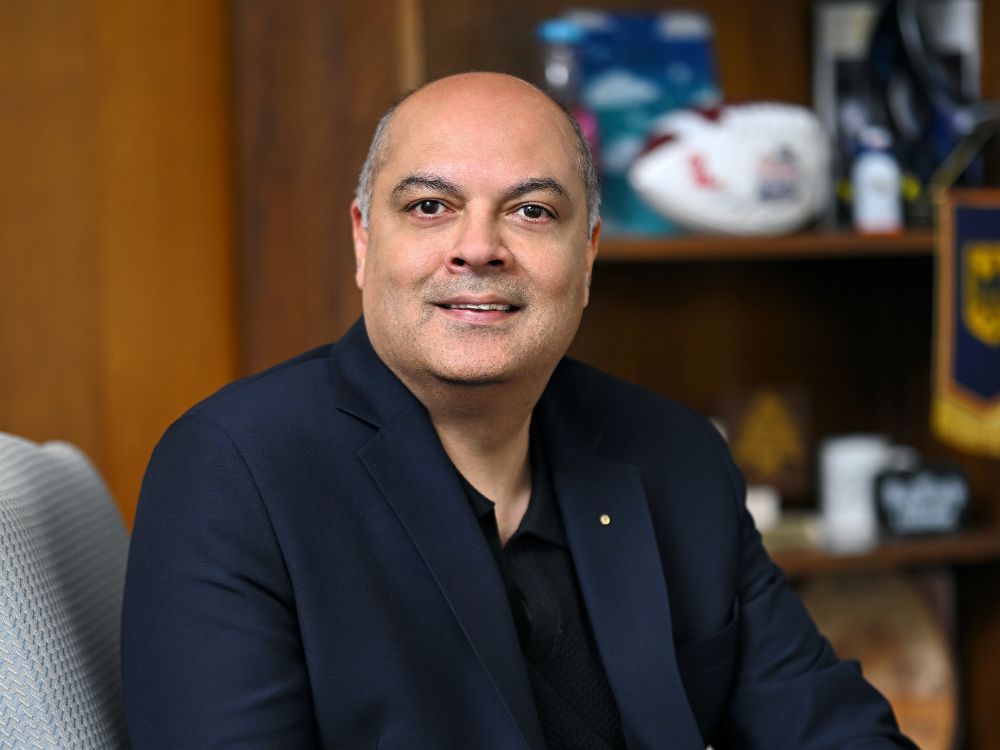
CEO Sanjeev Ahuja leads Lions Club International headquartered in Oak Brook
Service organizations are a great way to find a place to belong, make friends and contacts, and serve in your local community. Lions Clubs International (LCI), the world’s largest service society, is headquartered right here in the neighboring town of Oak Brook.
The origin of the group dates back to 1907. Founder Melvil Jones was a prominent member of several Chicago business circles. Jones had noticed an uptick in organizations primarily focused on networking. As a visionary of strong, local communities, he believed that if many of these groups joined forces, much more could be accomplished. Jones called a meeting at the LaSalle Hotel in the Loop and invited heads of the organizations to come and hear his thoughts. He floated the idea of combining efforts to create a larger, singular group that could not only connect community business leaders but also have a primary focus on service to each club’s local community.
The majority who attended that meeting merged with Jones’ group to form LCI. Today, there are over 1.6 million members in 49,000 clubs across 200 countries. Membership is open to anyone of legal age. “Just about anywhere I go in the world, I know I can get a cup of coffee and a smile with a fellow Lion,” said Sanjeev Ahuja, Executive Administrator (Chief Executive Officer) of LCI.
The name evolved from The Royal Order of Lions, the precursor organization, which was named in honor of the strength and dignity of a lion.
The hallmark of LCI is hands-on service in the local community. Lions pride themselves on being do-it-yourselfers. This is a group that looks for ways to get involved in service projects that directly impact a community. “Lions have no problem jumping in and going full force when they take on a project,” Ahuja knows. “Whether it’s building a municipal park, supporting a school’s sports sector, or rebuilding Japan after a disaster struck, you’ll find Lions nearby. They’re not afraid to get their hands dirty.”

Playground maintenance and cleanup in Bird Island, Minnesota.
With community service as the cornerstone, funding for projects is ongoing. Members pay dues to the organization. Local, district, and international dues are used to support the clubs around the world and manage organizational operations. Individual clubs fundraise to support specific local projects. Corporate partners also contribute.
Every dime raised is reinvested in the community. When a club or district wants to do a larger service project, the foundation requests a grant proposal. The proposal is reviewed by the Board of Trustees, and if the project meets the criteria, the money is allotted to carry out the project.
Since their founding, Lions have backed and staffed projects across the globe for disaster relief, hunger, environmental concerns, diabetes, and others. Their reach is far and their breadth is wide.
One major project into which they have invested heavily over the years is Lions Eye Banks. Corneas are harvested, collected, and transported to hospitals where they can be transplanted, a process which can restore a patient’s vision. Another project relevant to this one is the Lions Project for Canine Companions, particularly in the US, which provides guide dogs at no cost to the recipient and training to individuals who are blind or visually impaired.
Work to eradicate river blindness through surgery and medication is ongoing through a collaboration between Lions and the Carter Foundation. It’s a program that has benefited literally tens of thousands of children. In India alone, half a million dollars have been invested over the last half-century in building hospitals that provide eye surgery and treatment programs.
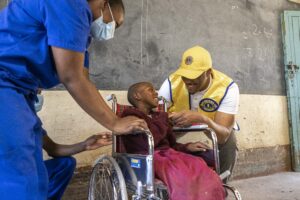
The Lions Club in Africa donates a wheelchair to a young child.
Across Africa, children suffering from cancer – and their families – can count on help through Lions’ partnership with Global Hope. The collaboration assists families in countries such as Uganda, Botswana, and Kenya with transportation to the nearest hospital – often a great distance in those countries – so the family does not have to carry their sick child along rural roads. Families are also supplied with food, medication, and funding for chemotherapy and alternative treatments.
In addition to well-being efforts, Lions take education very seriously. The organization has built schools across underdeveloped countries. They also support the Lions Quest Program – a social-emotional learning program that works to train teachers to help with mental health, anti-bullying, and drug prevention efforts in schools in over 70 countries worldwide.
Ahuja’s personal path to LCI began in 1999 when he took on a consulting project to revamp the Lions Eye Health Program. At the time, LCI was looking to revamp the messaging, positioning, and design of the program. Ahuja built a rapport with LCI as they reached out several more times for additional projects. A few years later, Ahuja had the opportunity to work with LCI again as they collaborated on strategic planning to build a digitized strategy through a mobile app and create digital communication and engagement, a core component of LCI’s strategy.
Once the plan was built, Ahuja came on board as the Chief Marketing and Membership Officer, and later the Chief Operations Officer. For the last four years, he has served as the Chief Executive Officer of LCI.
“I honestly thought I was going to implement the digital strategy and then go back to another startup,” said Ahuja. “I just became so interested because it’s a fascinating group. The chance doesn’t often come along to be part of such a large, international organization.”
LCI is a great place to introduce younger folks to service and giving back. When asked what he would like Oak Brook and the surrounding areas to know about LCI, Ahuja said, “It’s not your grandfather’s club anymore. We have intergenerational folks and we’re very family-oriented.” According to him, “It’s a great way to get engaged with your local community, make friendships that last a lifetime, and feel like you’re making a difference.”
