
End of an Era
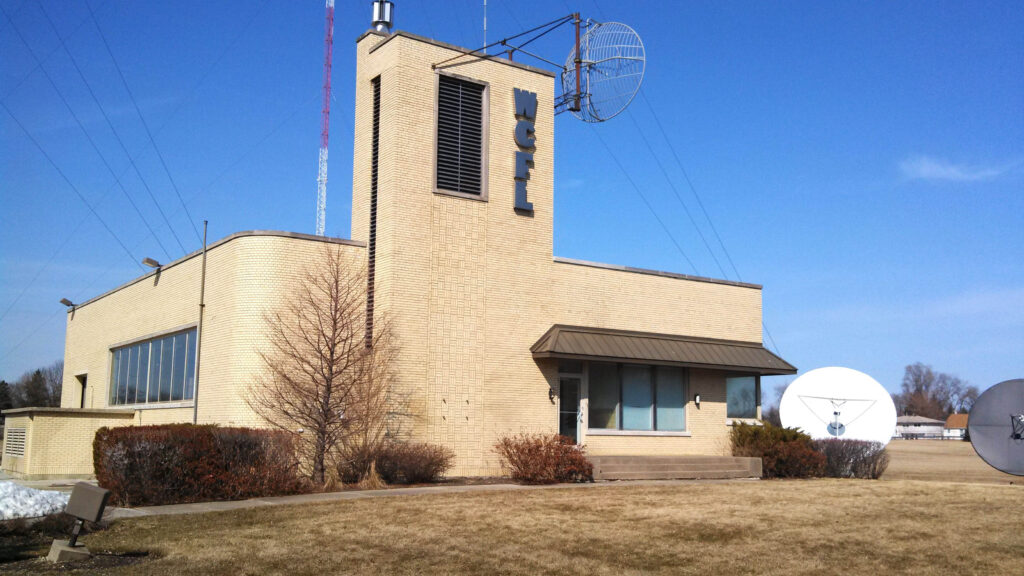
Photo courtesy of J.R. Russ
Three radio towers in Downers Grove were recently demolished after nearly a century of service
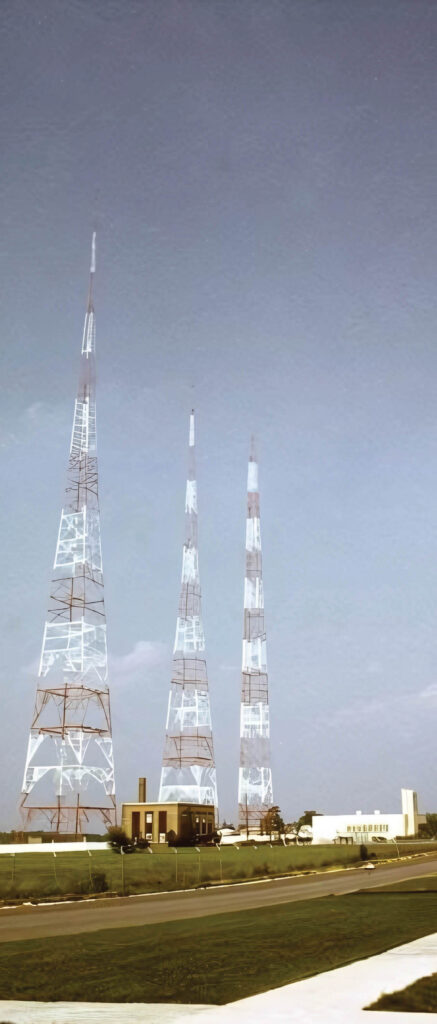
WCFL tower site circa 1972
Photo courtesy of Chicago Radio Archives and Memories
It was a dramatic sign-off to Downers Grove’s historic role in Chicago radio broadcasting when three towering structures located at the 100-block of 39th Street were demolished in early June. The three radio towers – once the heartbeat of WCFL, WLUP, and WMVP/ESPN 1000 – were all over 400-feet tall, the tallest standing at around 480 feet.
These towers were part of a major radio transmission site dating back almost 100 years. According to ABC7 News, these landmark towers, now just a memory, were erected in 2003, having replaced the original transmitter towers from 1932.
The Downers Grove transmission site spanned nearly 20 acres, Radio World documented, and according to J.R. Russ, Creator and Program Director of WCFLchicago.com, in addition to the three towers, this site also housed a building with a “small studio there that could be used to broadcast in emergencies.”
Russ, now in his 70s, grew up in New Buffalo listening to WCFL and its one-time competitor WLS, during a time he considers the “most exciting radio.” This inspired him to enter the radio industry, within which he has had a decades-long career.
Russ got his engineer license in Chicago back in 1970 from the Federal Communications Commission, and then he worked in radio “up and down the lake” before continuing on to various locations on the East Coast. He currently works in the Philadelphia market, but on a trip back home to the Midwest in 2015, he was able to visit and tour the Downers Grove transmission site. “There happened to be an engineer there that day, and he was happy to give a tour to another geek,” Russ said. “I just felt very blessed to get inside the fence and take pictures of the transmitter.”
Like many ends of an era, the closing and destruction of the Downers Grove transmission site may be considered bittersweet. Despite this, Russ described the collapsing of the radio towers as a “beautiful demolition.”
While not all the stations that historically were transmitted from Downers Grove were still operational, the site remained in service, particularly for WMVP/ESPN 1000, until recently, when the transmission site moved to a larger one in Joliet. This transmission relocation allows for broadcasts to reach a larger coverage area, according to Radio World.
The acreage of the former Downers Grove transmission site was reportedly sold and is slated for a 35-single-family home development by M/I Homes.
WCFL’s Storied History & Recent Resurgence
WCFL started as a Labor station, the first and longest-running one. It was created by the Chicago Federation of Labor (hence the CFL in the call letters) in 1926 to serve the labor movement and working-class communities, according to the Encyclopedia of Chicago.
The station’s focus changed numerous times since then, featuring sports, rock music, and ultimately taking on a religious format before ceasing operation in the late 1980s. WCFL’s glory days started in 1965, though, when it became a Top 40 music station, competing with the previous market leader WLS.
For about two decades, WCFL broadcast from the then-new Marina City in downtown Chicago, helping to put the famed cylindrical buildings on the map. J.R. Russ said that during the station’s lifetime, it featured many famous disc jockeys, including Joel Sebastian, Dick Biondi, and Clark Weber.
While WCFL is no longer broadcasting live on either an AM or FM dial, those nostalgic for the voices, jingles, and music from the station’s heyday are in luck. Around 2013, Russ brought many of these back to life when he started WCFLchicago.com.
Russ received permission to use WCFL jingles and DJ air checks to give today’s online listeners an authentic taste of what the station sounded like in its prime. “It’s on the web, available everywhere,” Russ said of WCFLchicago.com. “Many people have discovered it because it’s unique.”
WCFL started as “The Voice of Labor,” and creating WCFLchicago.com was a “labor of love” for Russ. He hopes, however, that it allows the classic Top 40 iteration of WCFL “to be remembered by older people but discovered by younger people, having them thinking, ‘I haven’t heard radio this exciting before!’ and inspire them to recreate that in the future.”
To download the app to listen to WCFLchicago.com, visit WCFLchicago.appimize.app.
